Revenue growth is usually something to celebrate. More customers. More orders. More activity. More momentum. But sometimes the financial results do not feel nearly as good as the growth story suggests. Revenue is up 15% or 20%, yet cash is tight. The company is busier than ever, but the bank balance is not improving.
Management starts asking a frustrating question:
If the business is growing, where is the cash going?
That is often a sign of profit and cash leakage.
Growth itself is not a problem. The issue is that growth can expose weaknesses in pricing, margins, working capital, capacity, and spending that were less noticeable when the business was smaller. The answer is not simply to grow faster. It is to understand how revenue is converting into profit and how profit is converting into cash.
Growth Does Not Automatically Create Cash
A company can grow revenue significantly and still consume cash.
Consider a business that increases sales from $20 million to $24 million.
At first glance, a 20% increase sounds great.
But what if:
- customers are paying more slowly?
- growth is concentrated in lower-margin products?
- discounts increased to win the new business?
- inventory had to increase substantially?
- overtime and temporary labor increased?
- headcount was added ahead of demand?
- suppliers require payment before customers pay?
- capital expenditures increased to support additional capacity?
The additional revenue is real. But so are the additional cash requirements. That is why I think one of the most important questions management should ask during periods of growth is:
For every additional dollar of revenue, how much profit and cash are we actually keeping?
If leadership cannot answer that question, growth can quickly become harder to manage than expected.
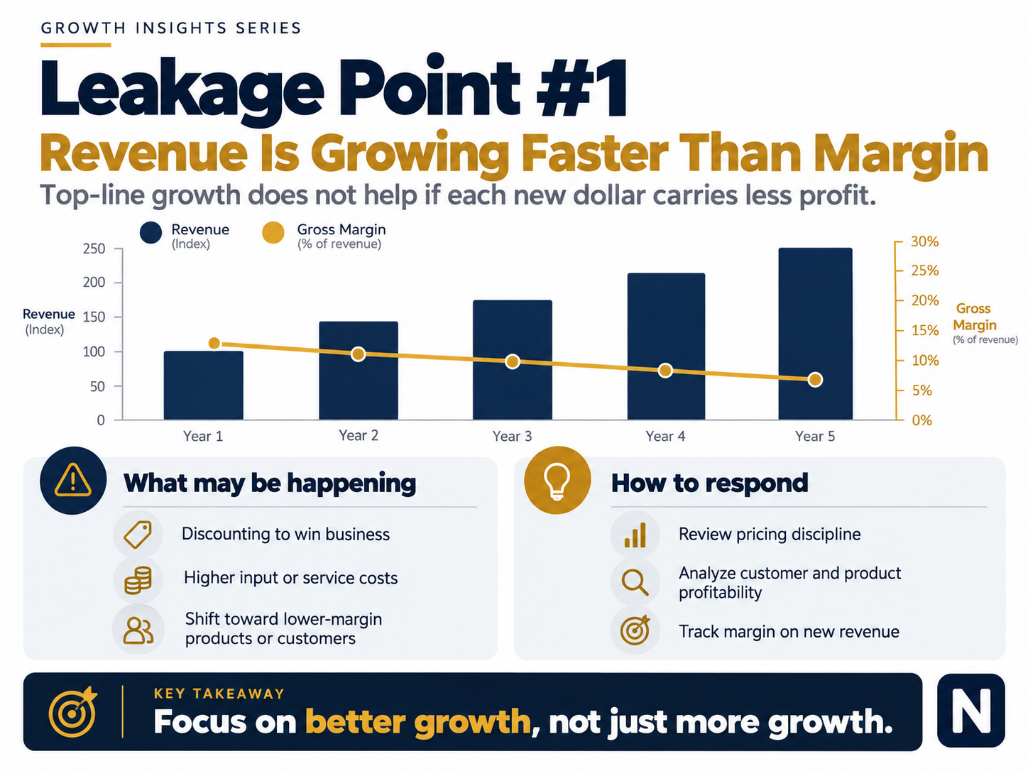
Leakage Point #1: Revenue Is Growing Faster Than Margin
The first place to look is gross margin.
A business may be winning more customers while making less money on each dollar of revenue. This can happen gradually. Sales teams may discount to close deals. Material or labor costs increase but pricing does not keep pace. Customers shift toward lower-margin products. Freight or service costs increase. A high-volume customer negotiates better terms. Revenue grows, but profitability does not grow with it.
For example, imagine revenue increases 15%, but gross profit increases only 5%.
That tells us something important is happening beneath the top line.
The question is not simply: Did revenue grow?
The better questions are:
- Did price keep pace with cost?
- Is product or customer mix changing?
- Which customers are generating the incremental growth?
- What margin are we earning on that new revenue?
- Are service requirements increasing without additional pricing?
A good FP&A process should make those relationships visible.
Sometimes the right answer is not more growth.
It is better growth.
Leakage Point #2: Customers Are Taking Longer to Pay
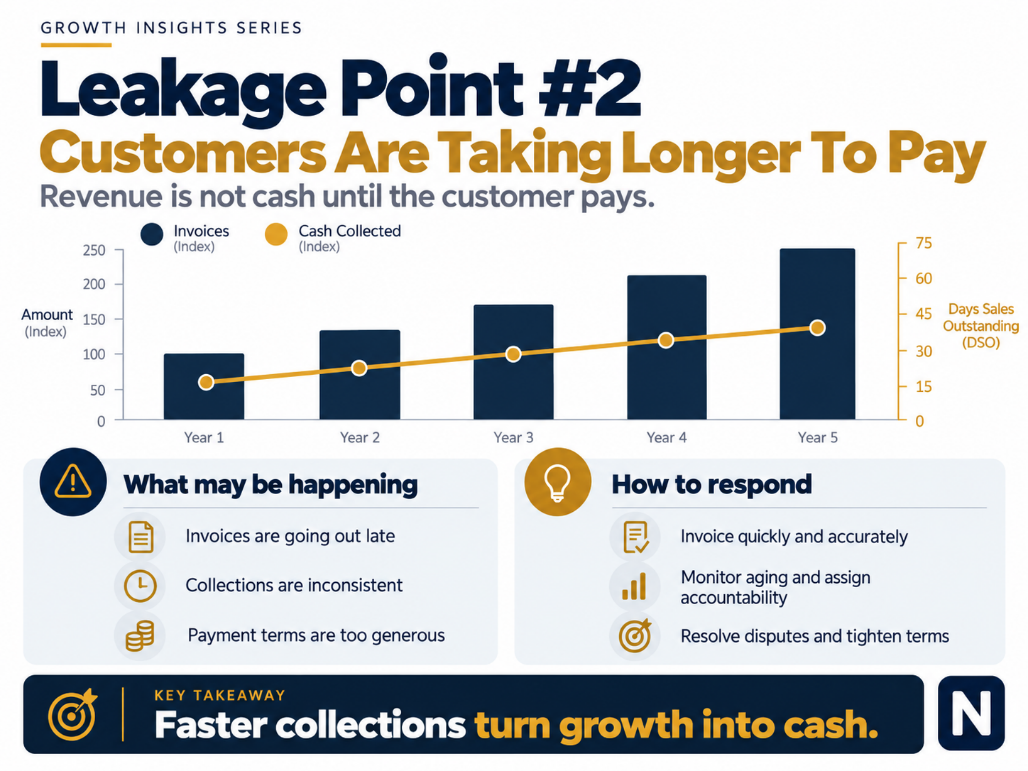
One of the easiest ways for a growing company to run into cash pressure is through accounts receivable.
Suppose revenue grows 20%. If receivables also grow 20%, that may be expected. But if receivables grow 35% or 40%, the company is effectively financing more of its customers' operations.
This can happen because:
- invoices are going out late
- collections are inconsistent
- payment terms have become more generous
- customers are disputing invoices
- sales teams are negotiating terms without considering the cash impact
Days Sales Outstanding, or DSO, becomes especially important during growth.
Even a relatively small increase in collection time can tie up a meaningful amount of cash.
The solution is not necessarily aggressive collections. Often the best improvements come from tightening the entire order-to-cash process:
- invoice quickly
- establish clear payment terms
- resolve billing disputes faster
- monitor aging consistently
- assign accountability for overdue balances
- incorporate payment behavior into customer decisions
Revenue is not cash until the customer pays.
Leakage Point #3: Inventory Is Growing Faster Than Sales
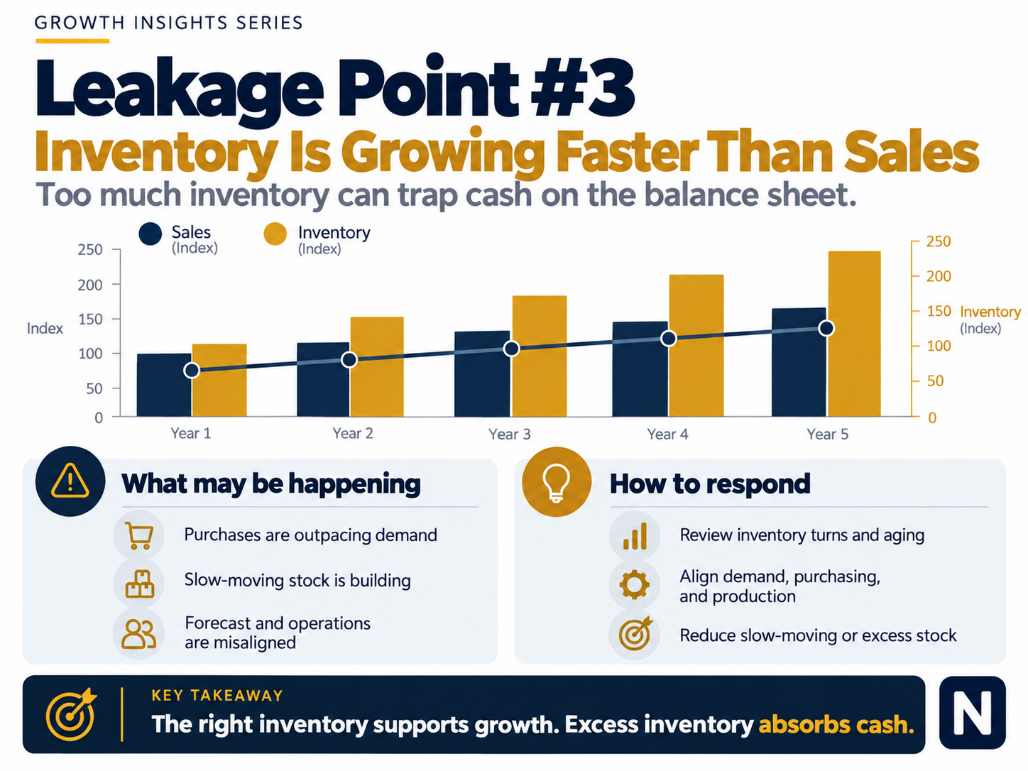
For product-based businesses, inventory can absorb cash very quickly. Growth often requires more inventory, which is normal. However, inventory should grow because the business needs it—not simply because purchasing, production, and demand planning are disconnected.
Common warning signs include:
- inventory growing faster than revenue
- declining inventory turns
- increasing obsolete or slow-moving stock
- large safety-stock levels
- purchases based on outdated forecasts
- excess inventory in low-margin or declining products
This is where forecasting becomes especially valuable. Sales expectations, production planning, purchasing, and finance should be working from the same assumptions. If sales expects one level of demand while operations plans for another, working capital can grow much faster than the business. The objective is not to minimize inventory at all costs. It is to maintain the right inventory to support demand without unnecessarily trapping cash on the balance sheet.
Leakage Point #4: Growth Is Adding Overhead Faster Than Revenue Can Support It
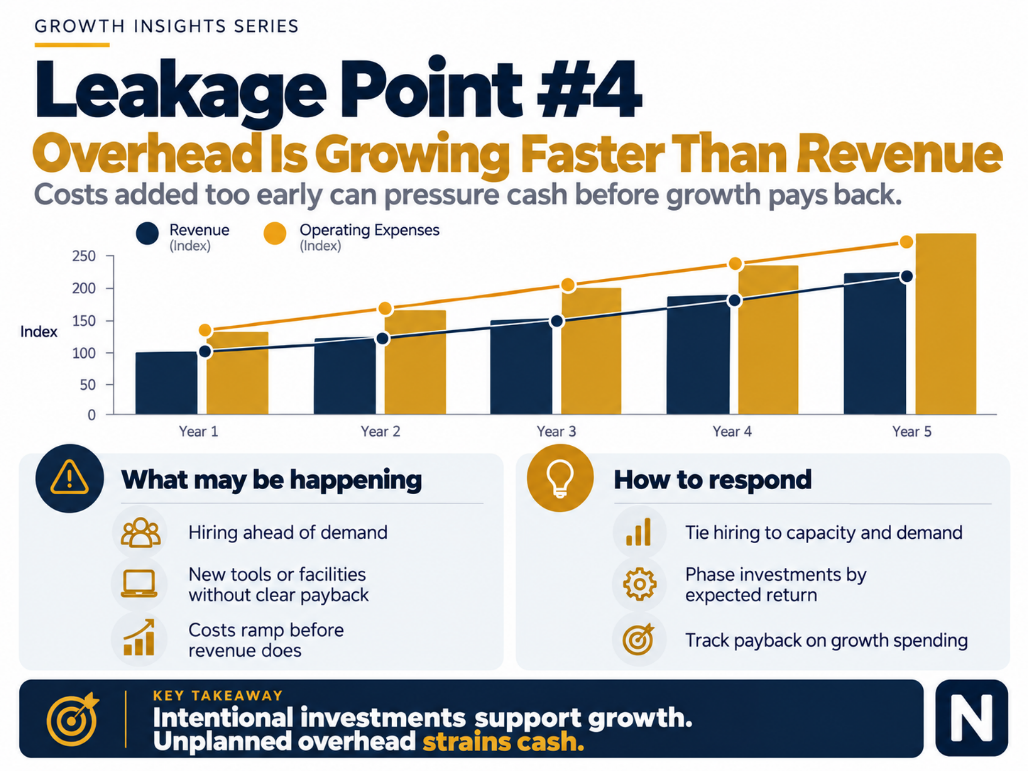
Another common issue occurs when companies invest ahead of growth. New employees are hired. Management layers are added. Additional software is purchased. Facilities expand. Consultants or contractors are brought in.
Sometimes those investments are exactly what the company needs. The problem occurs when nobody connects the timing of the investment to the expected financial return.
For example, hiring five people may increase costs immediately. But the associated revenue may take six months to materialize. That gap has a cash impact.
This is why headcount planning should include:
- when the person will start
- when the cost begins
- what capacity the role creates
- what revenue or productivity improvement is expected
- how long it takes for the benefit to appear
Growth investments should be intentional. Otherwise, a company can build the cost structure for tomorrow before tomorrow's revenue arrives.
Leakage Point #5: Profit Is Being Consumed by Working Capital
This is one of the most important concepts for growing businesses.
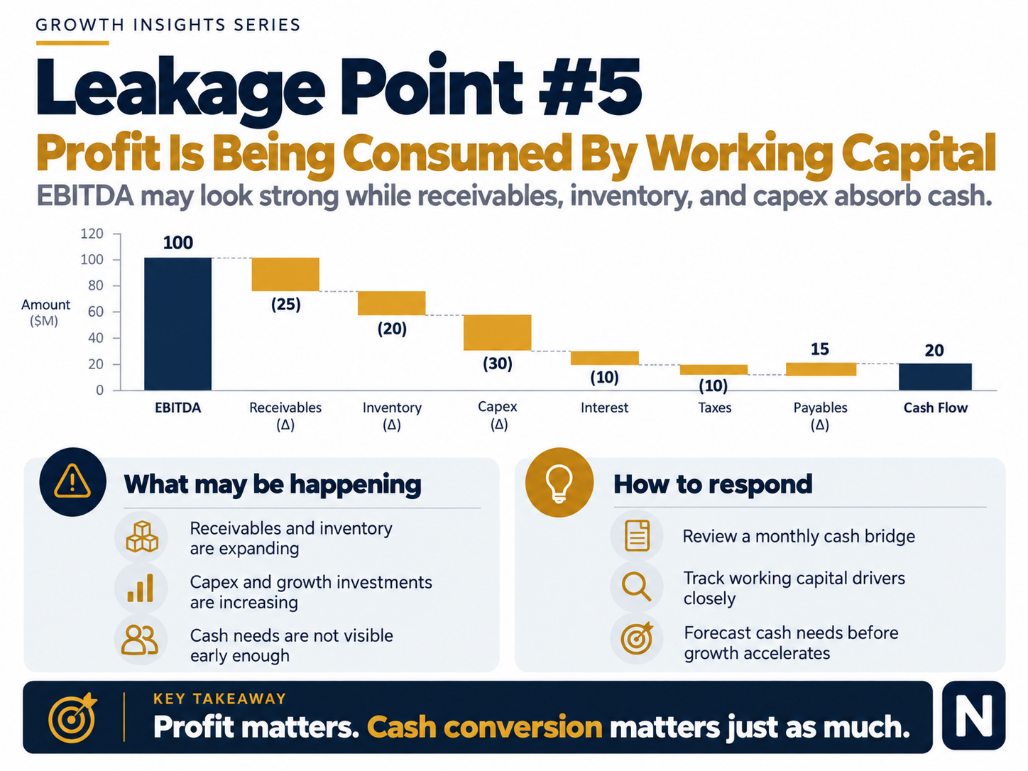
A company can report strong EBITDA and still experience weak cash flow. The income statement and cash flow statement tell different parts of the story.
Growth may require cash to fund:
- receivables
- inventory
- prepaid expenses
- capital expenditures
- debt service
- taxes
That means management should not stop at EBITDA.
A useful monthly review should include a cash bridge showing how operating profit turned into actual cash generation.
For example:
- EBITDA
- –Increase in receivables
- –Increase in inventory
- +Increase in payables
- –Capital expenditures
- –Interest
- –Taxes
That bridge often explains why a profitable business feels cash constrained.
The Solution: Connect Growth, Profit, and Cash
The goal is not to slow growth. It is to make growth financially productive. That starts with better visibility.
I would focus management attention on a small set of questions each month:
- 1Where is revenue growth coming from?
- 2What margin are we earning on that growth?
- 3Which customers and products are creating the most profit?
- 4How quickly are we converting sales into cash?
- 5Is inventory growing appropriately relative to demand?
- 6Are operating expenses growing faster or slower than revenue?
- 7How much cash is required to support the next stage of growth?
These questions connect the income statement, balance sheet, and cash flow statement to the operating decisions behind them.
Growth Should Create Financial Flexibility
Strong growth should eventually create more options for a business.
- More cash to invest.
- More capacity to hire.
- More ability to reduce debt.
- More flexibility to make acquisitions.
- More value for ownership.
If revenue is growing but those options are not improving, it is worth examining what is happening underneath the headline numbers. The important thing is to identify those leaks early because revenue growth by itself is not the objective, profitable, cash-generating growth is.