Greater Chicago & the Midwest
Annual Budgeting & Business Planning for Growing Companies
Turn the annual budget into a management tool—not just a finance exercise.
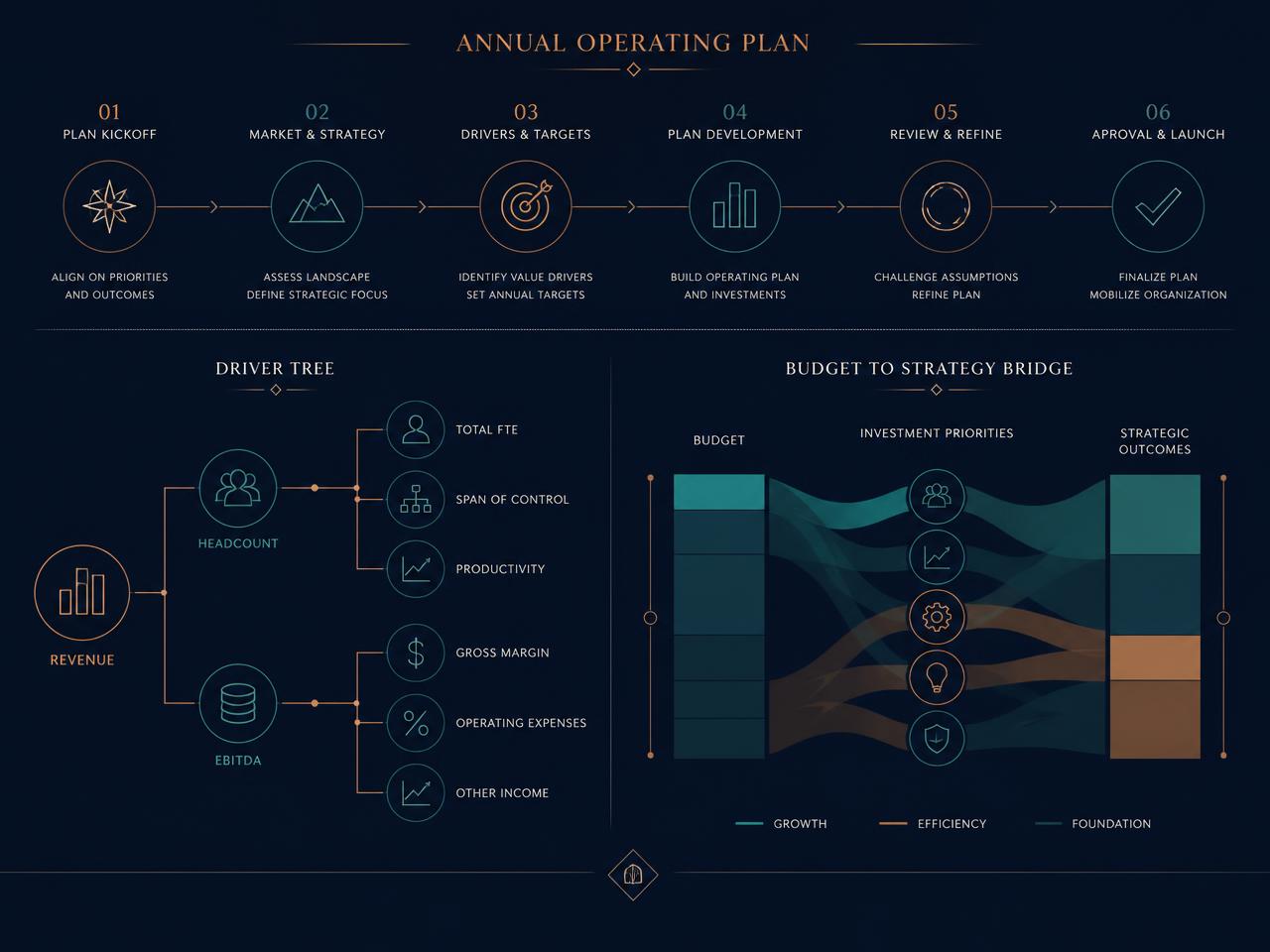
We help privately held and PE-backed businesses build practical, driver-based budgets that connect strategy, sales, staffing, operating expenses, capital spending, and cash flow.
- Driver-based budgeting
- Headcount & CapEx planning
- Integrated cash plan
- Scenario analysis
Designed for growing businesses generally between $10M and $100M in annual revenue. Serving businesses throughout Greater Chicago and the Midwest.
The core problem
A Budget Should Explain How the Business Plans to Win
Many companies create an annual budget. Far fewer create a planning process management actually uses to run the business.
How the budget often gets built
- Start with prior-year actuals
- Apply a percentage increase
- Ask departments to reduce spending
- Adjust the final number until EBITDA reaches a target
That produces a financial target. It does not necessarily produce an operating plan.
What management should be able to see
- What revenue growth actually requires
- What staffing is needed to support the plan
- Where spending increases—and why
- What margins the plan expects to deliver
- What capital investment is required
- What cash impact the plan produces
A good budget should translate business strategy into measurable operating and financial assumptions.
Five planning questions
Can Your Current Budget Answer These Questions?
What operational assumptions must be true for us to achieve the revenue plan?
What staffing and capacity are required to support growth?
Where are we intentionally investing more—and why?
What EBITDA and cash flow should the plan generate?
Who owns each major assumption and outcome?
The value of a budget is not the spreadsheet. It is the alignment and accountability behind the numbers.
Warning signs
Signs Your Budgeting Process Needs Improvement
- The annual budget takes several months to complete.
- Finance owns most of the assumptions.
- Department leaders do not understand how their budgets were built.
- Revenue targets are not tied to sales capacity, pipeline, backlog, or other business drivers.
- Headcount planning is maintained separately from the financial budget.
- Capital expenditures are not integrated into cash planning.
- Budgets are heavily based on prior-year spending.
- Management focuses on expense reductions rather than resource allocation.
- Budget assumptions are not clearly documented.
- The completed budget becomes outdated quickly.
- The CEO receives a financial budget but not a clear operating plan.
- No one is clearly accountable for significant budget assumptions.
If several of these conditions exist, the company may have a planning-process gap—not simply a budgeting problem.
What good looks like
A Strong Budget Connects Strategy to Financial Outcomes
Strategy Driven
The budget should reflect:
- Growth priorities
- Margin objectives
- Key investments
- Strategic initiatives
- Risk assumptions
Driver Based
Revenue and expenses should connect to measurable operating assumptions:
- Volume
- Pricing
- Capacity
- Headcount
- Utilization
Cross Functional
Planning should involve:
- Sales
- Operations
- HR
- Finance
- Functional leaders
Integrated
The budget should connect:
- Income statement
- Balance sheet
- Cash flow
Accountable
Major assumptions should have clear owners:
- Named owner per assumption
- Agreed targets
- Defined reporting cadence
The best budgeting process creates management alignment before the year begins.
Driver-based budgeting
Build the Budget From the Drivers of the Business
Driver-based budgeting starts with operational assumptions rather than financial percentages. Each industry has its own small set of drivers that explain most of the outcome.
Manufacturing
- Units produced
- Pricing
- Material cost
- Labor hours
- Capacity
- Scrap
- Capital spending
Technology & Subscription Services
- ARR / MRR
- Net revenue retention
- New bookings
- Churn
- Pricing tiers
- Expansion revenue
- Usage / consumption
- Customer acquisition cost
Professional Services
- Headcount
- Billable utilization
- Bill rate
- Realization
- Backlog
- Hiring timing
Specialty Trades
- Backlog
- Project starts
- Labor
- Service agreements
- Installation volume
- Equipment
Recurring Revenue Businesses
- Beginning customers
- Retention
- Churn
- New bookings
- Pricing
- Expansion revenue
The financial budget should be the result of operating assumptions—not the starting point.
Revenue planning
Start With a Credible Revenue Plan
Revenue planning should connect the financial target to the commercial engine of the business. The question is not what number leadership wants—it is what the business must actually do to achieve it.
Typical planning inputs
- Existing customers
- Customer retention
- Backlog
- Sales pipeline
- Conversion rates
- Pricing
- Volume
- Sales capacity
- Seasonality
- Acquisitions
- New locations
- Existing Revenue
- Retention
- Price
- Volume
- New Business
- = Revenue Plan
Revenue targets become more useful when management can explain exactly what must happen operationally to achieve them.

Headcount planning
Connect Workforce Decisions to the Financial Plan
Compensation is often the single largest expense in a growing business—and the one most likely to be planned outside the budget model.
What the headcount plan should include
- Existing employees
- Open positions
- Planned hires
- Start dates
- Salary
- Incentives
- Payroll taxes
- Benefits
- Merit increases
- Promotions
- Vacancies
- Turnover assumptions
Questions worth answering for every position
- When is the hire actually needed?
- What revenue or productivity supports the position?
- What is the full-year versus partial-year cost?
- What happens if hiring occurs three months earlier or later?
Every hiring decision is both an operating decision and a financial decision.
Operating expenses
Budget Resources Based on Priorities, Not Just Prior-Year Spending
Separating spending into categories lets management allocate resources toward the priorities most important to the business while maintaining financial discipline—and makes it far easier to adjust when conditions change.
Run-the-Business Costs
Expenses required to maintain existing operations at current service levels.
Growth Investments
Expenses intended to support future revenue or build new capabilities.
Strategic Initiatives
Specific investments tied directly to management priorities for the year.
Discretionary Spending
Costs that can be modified during the year based on actual performance.
A strong budget tells management not only how much it plans to spend—but why.
Capital expenditures
Integrate Capital Decisions Into the Operating Plan
Capital spending should not be planned on a separate schedule from the financial budget. It changes capacity, depreciation, cash, and financing all at once.
What to include
- Equipment
- Technology
- Facilities
- Vehicles
- Automation
- Expansion
- Major maintenance
What each investment should show
- Investment amount
- Timing
- Depreciation
- Cash requirements
- Financing
- ROI
- Payback
- Capacity impact
Capital spending affects operating capacity, depreciation, cash flow, and financing—all of which should be visible in the plan.
Cash & funding
Make Sure the Plan Is Financially Fundable
A profitable budget can still create liquidity pressure. Growth consumes working capital, capital projects consume cash, and debt service arrives on its own schedule.
- Revenue Plan
- Profitability
- Working Capital
- Capital Spending
- Debt Service
- Cash Flow
What management should understand before approving the plan
- Cash generated by the plan
- Working-capital needs
- Debt-service requirements
- Financing needs
- Minimum cash
- Investment capacity
A plan is incomplete until management understands how it will affect cash.
Budget vs. forecast
Budget and Forecast Serve Different Purposes
Budget
What management plans to achieve.
- Establish annual targets
- Allocate resources
- Align management
- Establish accountability
Typically developed annually
Forecast
What management currently expects to happen.
- Update expectations
- Identify risk
- Evaluate changing conditions
- Guide management actions
Typically refreshed monthly or quarterly
The budget sets the plan. The forecast keeps the plan relevant.
Scenarios
Build Flexibility Into the Plan Before the Year Begins
Conditions will change. Deciding in advance what management would do makes the response faster and less emotional.
Base Plan
Current management expectations for the year.
Upside
Potential performance if:
- Demand is stronger
- Hiring accelerates
- Pricing improves
- Strategic initiatives outperform
Downside
Potential performance if:
- Revenue misses
- Costs rise
- Collections slow
- Projects are delayed
The objective is not to predict every scenario. It is to identify the actions management may need to take if conditions change.
Accountability
The Budget Should Belong to the Business—not Just Finance
Each meaningful planning assumption should have a named owner who understands it and can act on it during the year.
Sales
- Pipeline
- Bookings
- Volume
- Pricing
Operations
- Productivity
- Labor
- Capacity
- Material assumptions
HR
- Hiring
- Compensation
- Benefits
Department Leaders
- Discretionary spending
- Strategic initiatives
Finance
- Consolidation
- Challenge
- Financial integration
- Scenario analysis
- Reporting
Finance should facilitate the planning process—not invent the business plan.
Planning calendar
A Practical Annual Planning Process
- Phase 1
Strategic Direction
Leadership establishes:
- Priorities
- Growth expectations
- Investment themes
- Financial objectives
- Phase 2
Assumptions
Develop:
- Revenue drivers
- Pricing
- Hiring
- Margin
- CapEx
- Macro assumptions
- Phase 3
Department Planning
Functional leaders develop:
- Operating plans
- Resource requirements
- Phase 4
Financial Integration
Finance consolidates:
- Income statement
- Balance sheet
- Cash flow
- Phase 5
Executive Review
Management evaluates:
- Tradeoffs
- Scenarios
- Risk
- Resource allocation
- Phase 6
Finalize & Communicate
Establish:
- Targets
- KPIs
- Ownership
- Reporting cadence
The budget process should create alignment before it creates a spreadsheet.

Deliverables
Budgeting & Planning Deliverables
- Annual operating budget
- Revenue plan
- Driver-based budget model
- Department templates
- Headcount plan
- Compensation plan
- Operating expense plan
- Capital expenditure plan
- Integrated cash-flow plan
- Budget assumptions register
- Scenario analysis
- Business-unit budgets
- Executive budget presentation
- Board budget package
- Monthly variance reporting structure
- Annual planning calendar
After approval
The Planning Process Should Continue After the Budget Is Approved
Monthly
Review:
- Actual versus budget
- Revenue drivers
- Margin
- Operating expenses
- EBITDA
- Cash
- KPIs
Quarterly
Review:
- Updated forecast
- Strategic initiatives
- Resource allocation
- Major risks
Annually
Restart the formal planning cycle:
- Strategic direction
- Assumptions
- Department plans
- Integrated financials
A budget creates value only when management uses it to understand performance and adjust decisions. Budgeting is frequently delivered inside fractional FP&A support or during interim FP&A leadership engagements, and it pairs closely with profitability analysis.
Timing
When Should You Bring in Budgeting & Planning Support?
- Budget season is approaching and existing processes are weak.
- The CFO or Controller is overloaded.
- The company has never built a driver-based budget.
- Management wants more operational accountability.
- The company is growing rapidly.
- New PE ownership requires a stronger planning process.
- Multiple business units need consistent planning.
- The existing budget model is difficult to maintain.
- Finance needs help connecting strategy to financial outcomes.
- Management wants to integrate budgeting and forecasting.
External support should strengthen the existing finance team and create a repeatable planning process the company owns.
FAQ
Budgeting & Planning Questions
What is driver-based budgeting?
The budget is built from operational assumptions—volume, pricing, headcount, utilization, backlog, and capacity—rather than simply increasing prior-year financial results by a percentage. The financial statements become the output of the operating plan instead of the starting point.
What is the difference between budgeting and forecasting?
Budget = what management plans to achieve. Forecast = what management currently expects to happen. Strong FP&A uses both: the budget sets annual targets and accountability, and the forecast keeps expectations current as conditions change.
How long should the annual budget process take?
Timing varies by company size, structure, and complexity. What matters more than duration is design: a clear calendar, defined assumptions, department templates, and an executive review process reduce unnecessary iterations and avoid the drift that stretches budgets over many months.
Who should participate in the budget process?
Finance, executive leadership, and the business leaders who own the major operating assumptions—typically sales, operations, HR, and functional department heads.
Should our budget include a balance sheet and cash flow?
Generally yes, where practical. Management should understand the liquidity and working-capital implications of the operating plan, not only the expected profit.
Can you improve our existing budget model rather than replace it?
Yes. We assess the existing model and process first. In many cases the fastest path is strengthening drivers, structure, and ownership within a model your team already understands.
Can you help facilitate budget meetings with department leaders?
Yes, where included in the engagement scope. Facilitation is often where the biggest improvement in alignment and accountability happens.
Do we need budgeting software?
Not necessarily. The right answer depends on company complexity, existing systems, number of contributors, and planning requirements. Many companies in this revenue range run an excellent process without buying new software.
Can budgeting support be part of a fractional FP&A engagement?
Yes. Annual budgeting is commonly integrated into recurring fractional FP&A services alongside forecasting, reporting, and decision support.
Next step
Build a Plan the Business Can Actually Manage Against.
Connect strategy, revenue, staffing, expenses, capital investment, and cash flow into a practical financial plan that creates alignment and accountability across management.
Serving privately held and PE-backed businesses throughout Greater Chicago and the Midwest.