For many business owners, selling a company represents the culmination of years—or decades—of work.
Yet one of the biggest mistakes an owner can make is waiting until the business is formally for sale to begin preparing for the transaction.
By that point, there may be limited time to address weaknesses in profitability, customer concentration, working capital, financial reporting, or the forecast. Issues that could have been improved over the prior year instead become items a buyer discovers during due diligence.
While an owner will market how much profit the business generated last year, a buyer wants to understand how sustainable the earnings are after the current owner transitions.
That is why owners considering a transaction should begin preparing well before engaging potential buyers. Ideally, the process starts 6–12 months before going to market, and potentially earlier for businesses with significant operational or financial improvements to make.
The objective is not simply to make the company look better.
It is to develop a clear, credible financial story that demonstrates the quality, predictability, and transferability of earnings.
Here are seven areas every owner should understand before beginning a sale process.
01
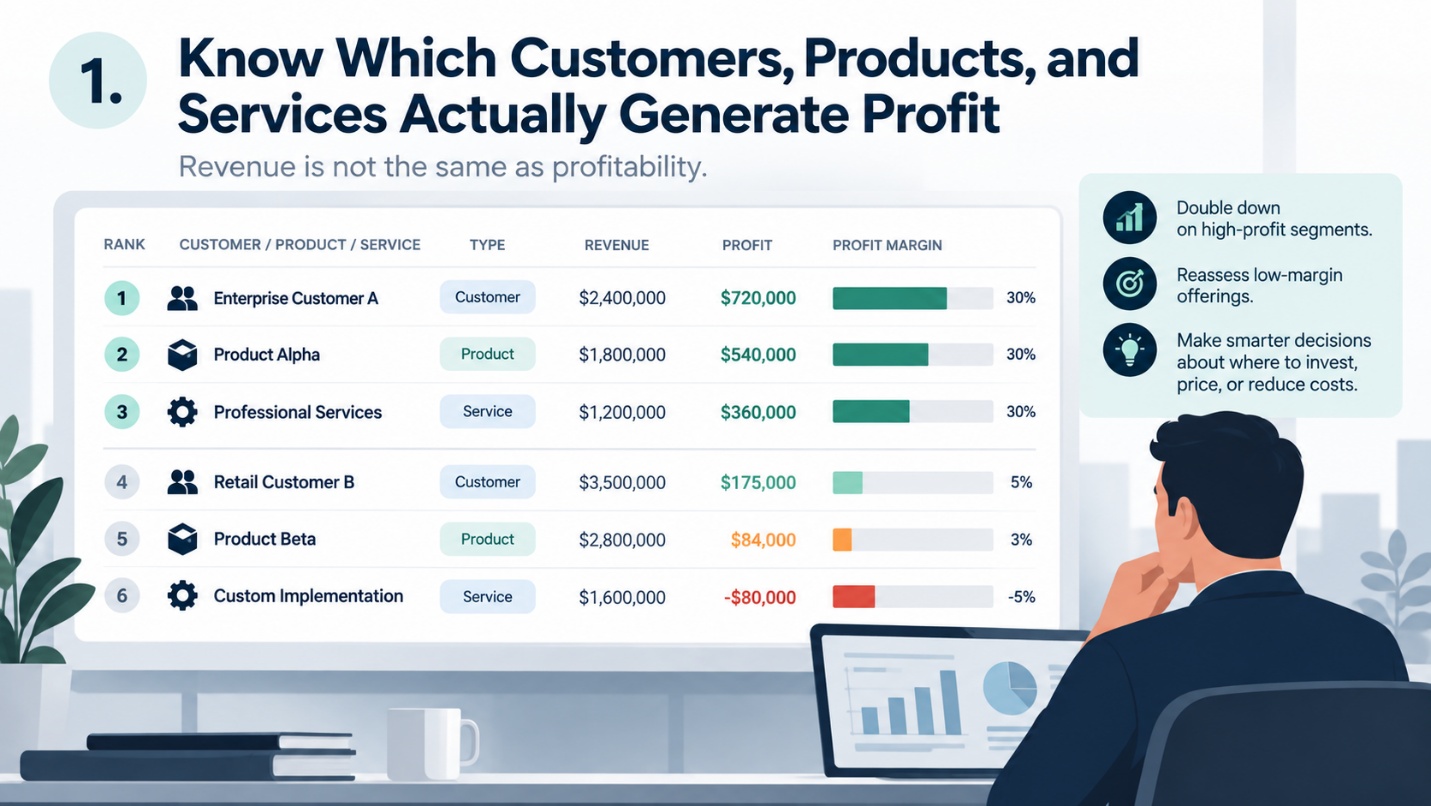
1. Know Which Customers, Products, and Services Actually Generate Profit
Most owners know their largest customers. They may also know their highest-revenue products or services. But revenue and profitability are not the same thing.
A large customer may require substantial discounts, expedited shipments, customized service, excessive support, or unfavorable payment terms. A high-volume product may consume significant labor or capacity while producing relatively little contribution margin.
Before a sale, owners should be able to answer questions such as:
- Which customers generate the most gross profit?
- Which products or services have the strongest margins?
- Where is profitability improving or deteriorating?
- Are certain customers consuming disproportionate resources?
- Which parts of the business should receive additional investment?
This analysis becomes important during a transaction because buyers are trying to understand what drives the economics of the business.
A company generating $2 million of EBITDA from several healthy customer and product segments may be viewed very differently from one producing the same EBITDA while relying heavily on a few low-margin relationships.
Customer and product profitability analysis can also identify actions that improve performance before the business goes to market.
Sometimes relatively modest changes—pricing adjustments, service-level changes, product rationalization, or renegotiated terms—can meaningfully improve earnings.
02
2. Understand How Predictable Revenue and Cash Flow Really Are
Historical growth is valuable. Predictable growth is even more valuable.
Buyers will want to understand how much confidence they can place in future revenue and cash flow.
For some businesses, predictability comes from recurring contracts or subscriptions. For others, it may come from long-standing customer relationships, repeat purchasing behavior, a healthy backlog, service agreements, or strong retention rates.
Owners should be prepared to explain:
That might include contracted revenue, recurring revenue, backlog, historical reorder patterns, or a well-supported sales pipeline.
The stronger the connection between operating activity and future financial results, the easier it becomes for a buyer to develop confidence in the forecast.
Cash-flow predictability matters as well.
A business may report healthy EBITDA but experience substantial volatility in cash because of inventory purchases, large receivable balances, seasonality, capital expenditures, or uneven customer payment patterns.
Understanding those dynamics before a sale helps prevent surprises during diligence.

03
3. Know Whether Margins Are Improving, Stable, or Declining
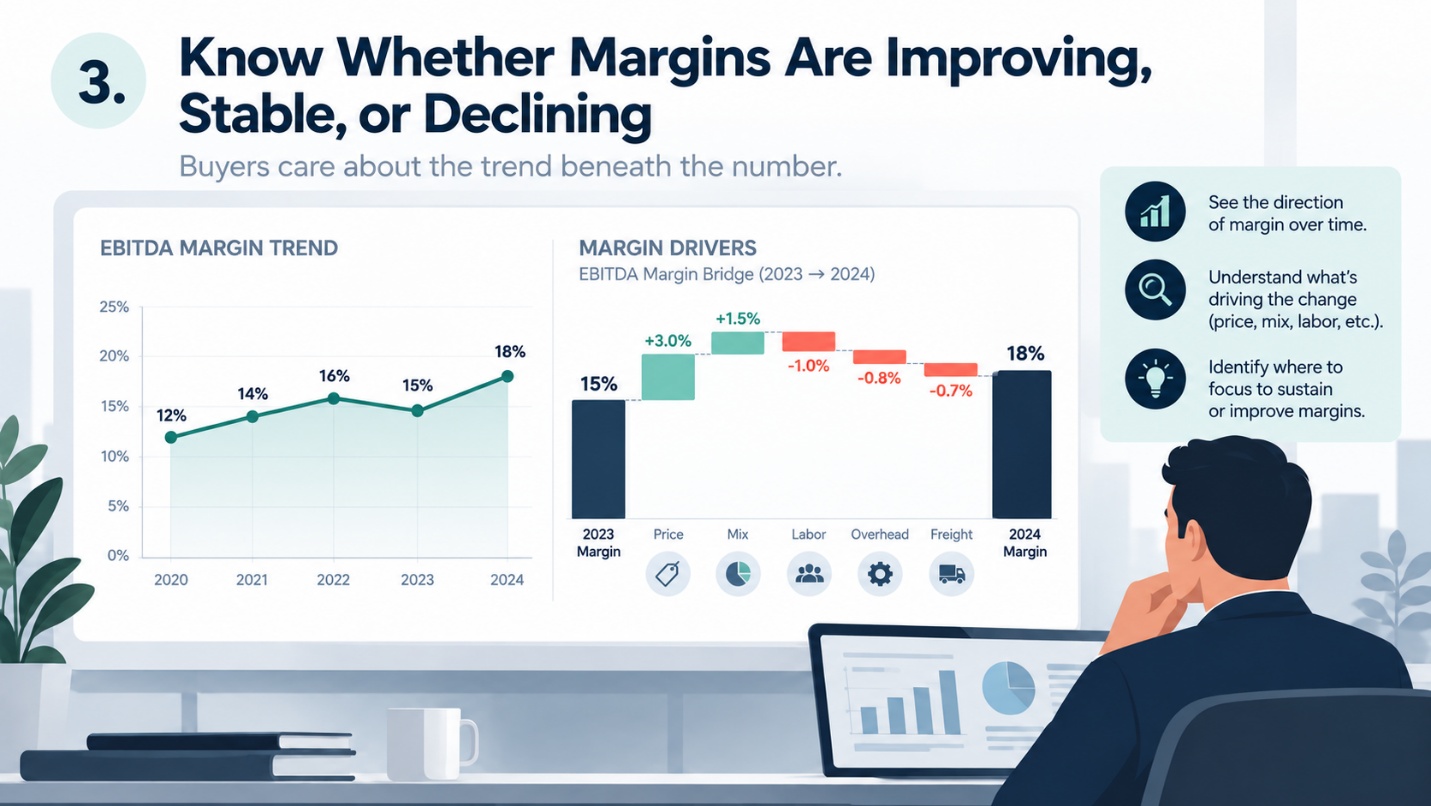
A buyer is rarely interested only in the current EBITDA number. They want to understand the trend underneath it.
Consider two companies that each generate a 15% EBITDA margin. One increased from 11% to 15% during the previous three years. The other declined from 19% to 15%. The current result is identical, but the trajectory tells very different stories.
Owners preparing for a sale should understand the drivers behind changes in gross margin and operating profit.
Questions worth answering include:
- Have prices kept pace with cost increases?
- Is labor productivity improving?
- Has the customer or product mix changed?
- Are overhead expenses growing faster than revenue?
- Are there temporary expenses affecting current results?
- Are recent improvements sustainable?
A useful analysis does more than report that margin increased or decreased.
For example: Gross margin increased 180 basis points because of a 4% price increase, improved product mix, and lower freight expense, partially offset by higher direct labor costs. That is considerably more informative than simply showing a monthly income statement. The goal is to help a prospective buyer understand the economic engine behind the results.
04
4. Address Customer—and Owner—Concentration
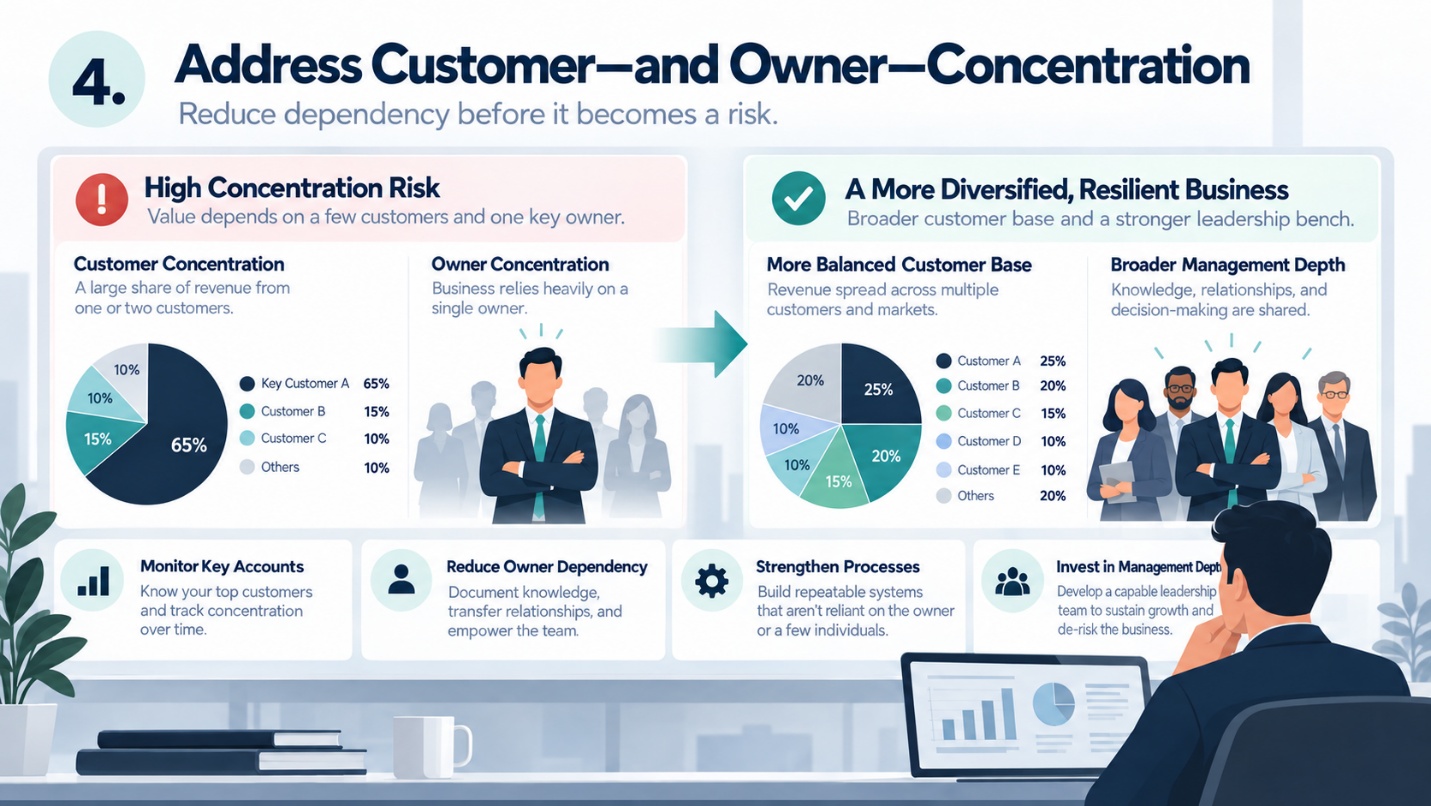
Customer concentration is one of the most common risks buyers evaluate.
If 35% of revenue comes from one customer, the buyer will naturally ask what happens if that relationship changes.
But customer concentration is only part of the issue.
Many privately held companies also have significant owner concentration.
The owner may personally manage the largest customers, approve every major pricing decision, oversee important vendor relationships, manage key employees, or possess institutional knowledge that exists nowhere else in the organization.
That creates an important transaction question:
The year before a potential transaction is an excellent time to reduce that dependency.
That may involve strengthening the management team, documenting processes, transferring customer relationships, delegating decision-making authority, or building reporting systems that do not depend on the owner's personal knowledge.
A business that operates through repeatable systems is generally easier for a new owner to understand and transition than one where critical information resides primarily with the seller.
05
5. Improve Working Capital Before It Becomes a Negotiating Issue
Working capital often receives less attention from owners than revenue or EBITDA.
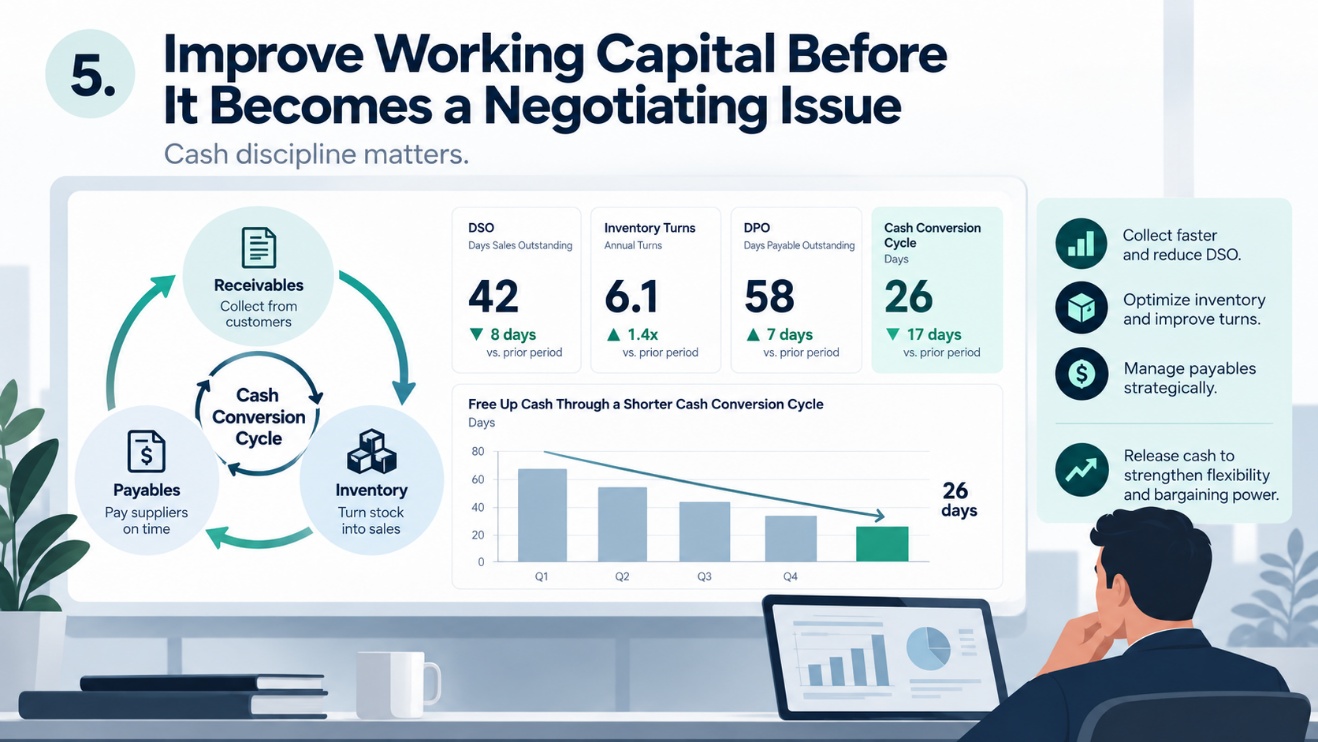
During a transaction, however, it can become extremely important. Buyers will examine receivables, inventory, payables, billing practices, collections, and historical working-capital requirements.
Poor working-capital management can create several problems. Old receivables may raise questions about revenue quality. Excess inventory can suggest weak demand planning. Slow billing processes can suppress cash flow.
And unusually low working capital immediately before the transaction may result in negotiations over the amount of working capital that must remain in the business at closing.
Six to twelve months before a transaction, owners should begin reviewing trends such as:
- Days sales outstanding
- Aging of receivables
- Inventory turns
- Obsolete or slow-moving inventory
- Vendor payment terms
- Billing cycle time
- Cash conversion cycle
Improving these metrics does more than make the balance sheet cleaner. It can release cash before a transaction while demonstrating stronger operating discipline.
06
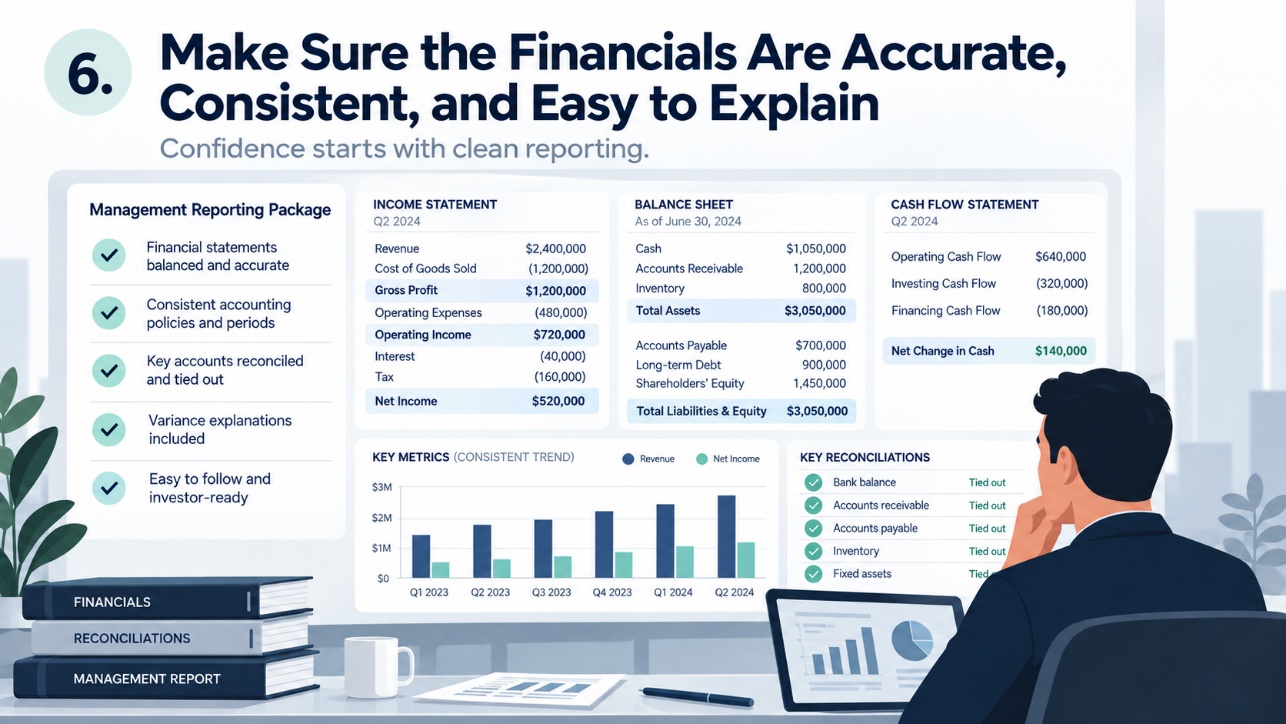
6. Make Sure the Financials Are Accurate, Consistent, and Easy to Explain
Financial diligence becomes considerably more difficult when management cannot easily reconcile its own numbers.
A buyer may request monthly financial statements, adjusted EBITDA calculations, customer revenue history, margin analysis, working-capital schedules, forecasts, and numerous supporting analyses. If those reports provide conflicting answers, confidence can deteriorate quickly.
That does not mean every business needs a sophisticated enterprise reporting system before pursuing a sale. It does mean the business should have a consistent financial
Ideally, the company has a reliable monthly close and management reporting process that includes:
- Income statement and balance-sheet trends
- Budget or forecast versus actual performance
- Revenue and margin analysis
- Key operating metrics
- Working-capital trends
- EBITDA adjustments
- Explanations of significant variances
Owners should also review potential EBITDA adjustments before the transaction begins.
Some adjustments may be legitimate owner-specific or nonrecurring expenses. Others may be challenged by a buyer.
07
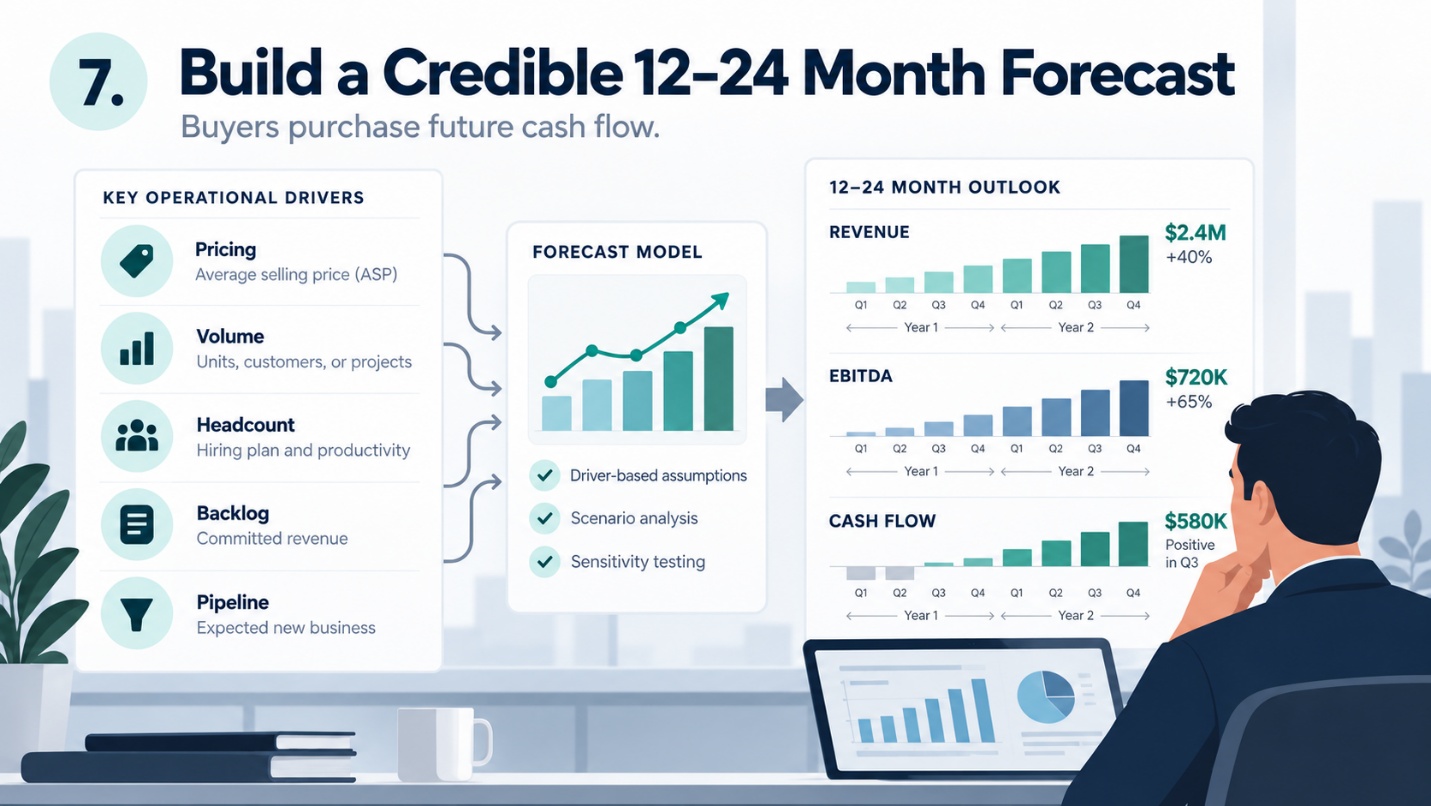
7. Build a Credible 12–24 Month Forecast
One of the most important documents in a sale process is often not historical. It is the forecast.
A buyer ultimately purchases the future cash flow of the business—not last year's financial statements. That makes the forecast an important bridge between historical results and the company's future opportunity.
Unfortunately, many privately held businesses either do not maintain a formal forecast or rely on a simple percentage-growth assumption.
A stronger forecast connects financial results to the operating drivers of the business.
Depending on the company, those drivers might include:
- Customer volume
- Units sold
- Pricing
- Headcount
- Utilization
- Contract renewals
- Sales pipeline
- Backlog
- New locations
- Production capacity
- Material or labor costs
The forecast should also be internally consistent.
Revenue growth may require additional employees, inventory, equipment, or working capital. Those requirements should appear in the financial outlook.
Buyers will test management's assumptions. A forecast grounded in identifiable business drivers is far easier to defend than one built around a top-line growth percentage.
It also gives the seller an opportunity to demonstrate that the company is not simply performing well today—it has a credible path for continuing to perform after the transaction.
Preparing for a Sale Is Really About Building a Better Business
Owners should not think of these activities merely as transaction preparation.
Almost everything that improves sale readiness also improves the business itself.
Better customer profitability analysis supports better pricing decisions.
A stronger forecast improves resource allocation.
Better working-capital management generates cash.
Reduced owner dependency strengthens the organization.
More consistent reporting improves management decisions.
And clearer operating metrics create greater accountability.
Those improvements have value whether the owner ultimately sells the business this year, three years from now, or decides not to sell at all.
The key is allowing enough time for improvements to become visible in the financial results.
One month before
Making a change one month before going to market may allow management to explain an initiative.
Twelve months earlier
Making the change twelve months earlier may allow management to demonstrate the results.
That distinction matters.
What Should an Owner Be Able to Explain Before Going to Market?
Before beginning a transaction process, an owner should be comfortable answering seven questions:
- 1Which customers, products, and services actually generate the most profit?
- 2How predictable are revenue and cash flow?
- 3Are margins improving, stable, or declining—and why?
- 4How dependent is the company on its largest customers or the owner personally?
- 5Is working capital being managed effectively?
- 6Are the financial statements accurate, consistent, and easy to explain?
- 7Is there a credible 12–24 month forecast tied to actual business drivers?
If those questions are difficult to answer today, that does not necessarily mean the business is not ready to sell.
It means there is work that can be done before the sale process begins.
And that is precisely why starting early matters.