A lot of forecasts start the same way. Take last year's numbers, add a growth percentage, make a few adjustments for known changes, and call that the plan. Revenue grew 7% last year, so maybe next year we assume 8%. Payroll increased 5%, so perhaps we will build in another 5%. Marketing expenses go up a little. Rent stays about the same. Maybe a few departments submit their estimates and finance pulls everything together.
The result may be a complete forecast. But does it really explain the business?
That is the question I think matters most.
A good forecast should do more than tell you what revenue, profit, or cash flow might be six months from now. It should help explain what must happen operationally for those results to occur.
That is the idea behind driver-based forecasting.
Instead of starting with financial statement lines, you start with the activities that create the financial results.
For a SaaS or subscription company, that might mean customers, ARR, churn, retention, pricing, and sales productivity. For a manufacturer or product-based company, it may be unit volume, price, product mix, material costs, labor, and production capacity. For a professional services business, the key drivers could be headcount, utilization, billing rates, and backlog.
Every business is different and the forecast should reflect that.
The problem with simply forecasting the financial statements
Imagine a company expects revenue to grow 10% next year.
That sounds straightforward, but where is the 10% actually coming from?
Are you expecting:
- more customers?
- higher prices?
- more units sold?
- stronger retention?
- new products?
- a larger sales team?
- an acquisition?
- expansion into a new market?
Those are very different growth stories, and they carry very different cost, cash flow, and execution implications.
If your forecast simply says revenue will increase 10%, management does not have much to work with.
A driver-based forecast asks a better question: What needs to happen in the business for revenue to increase by 10%?
That changes the conversation. Management cannot directly manage a revenue line on an income statement, but management can influence pricing, customer retention, sales conversion, production capacity, hiring, utilization, and dozens of other operational activities.
Those are the things the forecast should help leadership understand.
What does "driver-based" actually mean?
The concept is fairly simple. You identify the handful of variables that have the greatest impact on the business, and then you connect those variables to the financial forecast.
For example:
Or:
Or, in a professional services company:
The formulas themselves are not complicated.
And they do not need to be.
One of the mistakes I see with financial modeling is assuming that more detail automatically means a better forecast. It does not.
A model can have thousands of formulas and still do a poor job explaining the business.
The goal is to identify the few drivers that really matter and build the forecast around them.
SaaS and subscription businesses: start with customers and recurring revenue
Subscription businesses are a good example of why historical growth rates can be misleading.
Imagine a SaaS company that grew revenue 15% last year.
At first glance, that looks great.
But what if customer churn is also increasing?
What if most of the growth comes from price increases rather than new customers?
What if new bookings are slowing, but revenue still looks strong because prior contracts are flowing through the income statement?
You would not see those issues by looking at the revenue line alone.
A better model starts with the movement in recurring revenue.
For example:
Beginning ARR
+ New customer ARR
+ Expansion from existing customers
− Customer churn
− Customer contraction
= Ending ARR
Now management can see what is actually driving growth.
The key drivers might include:
- new customer additions
- average contract value
- pipeline conversion
- length of the sales cycle
- churn
- gross revenue retention
- net revenue retention
- expansion revenue
- pricing
- sales headcount
- salesperson productivity
This also helps connect growth plans to spending. Suppose the company plans to add five salespeople. A basic forecast might simply increase sales payroll. A driver-based forecast asks more questions:
- How long does it take for a new salesperson to become productive?
- How much pipeline should each salesperson generate?
- What percentage of that pipeline typically closes?
- What is the average contract value?
- How long does it take before those bookings convert into revenue?
Now we have something management can evaluate.
Instead of saying: Sales expenses are going up 20%.
The conversation becomes: We are adding five salespeople, assuming a four-month ramp period, and expecting each fully productive salesperson to generate approximately $1 million of annual contract value.
That is a much better planning discussion.
Product companies: volume, price, mix, and cost tell the story
A manufacturing, consumer products, or distribution company has a very different set of drivers.
Revenue might start with:
But even that may not be enough.
You may also need to understand:
- product mix
- customer mix
- channel mix
- promotional activity
- raw material costs
- freight
- labor
- production efficiency
- manufacturing capacity
- inventory levels
One of the most useful ways to think about this is through price, volume, and mix.
Let's say management expects revenue to grow 8%.
That could happen several different ways.
One scenario might be:
- Volume: +8%
- Price: 0%
- Mix: 0%
Another might be:
- Volume: +2%
- Price: +4%
- Mix: +2%
The top-line result may look similar, but the business implications are not.
If growth is coming mostly from higher volume, the company may need more labor, inventory, production capacity, freight, or warehouse space.
If most of the growth comes from pricing, the incremental margin could be much stronger.
If product mix is shifting, revenue may increase while profitability actually declines if customers are buying more lower-margin products.
Those differences matter. Once those drivers are visible, the forecast becomes much more useful.
Management can ask:
- What happens if material costs rise 5%; How much pricing would we need to recover that increase?
- What happens if production volume is below plan?
- Which products are creating the most incremental margin?
Those are the kinds of questions a forecast should help answer.
Professional services businesses: people often drive everything
Professional services companies have another completely different economic model.
For many of these businesses, capacity is one of the most important drivers.
Revenue might be modeled as:
That connects hiring directly to revenue capacity.
The important drivers may include:
- billable headcount
- utilization
- billing rates
- project backlog
- project duration
- hiring timing
- employee turnover
- compensation
- subcontractor usage
Suppose management wants to grow revenue 15%. It is easy to put 15% into a spreadsheet. But can the organization actually deliver that much work?
If utilization is already high, revenue growth may require additional hiring.
If it takes three months to recruit someone and another two months for that person to become fully productive, the company may need to begin hiring well before the revenue shows up.
That is why a good forecast can also become a workforce planning tool.
It helps management see when decisions need to happen, not just what the financial result might eventually be.
Different industries, same basic idea
The drivers will change from one company to another; the principle does not.
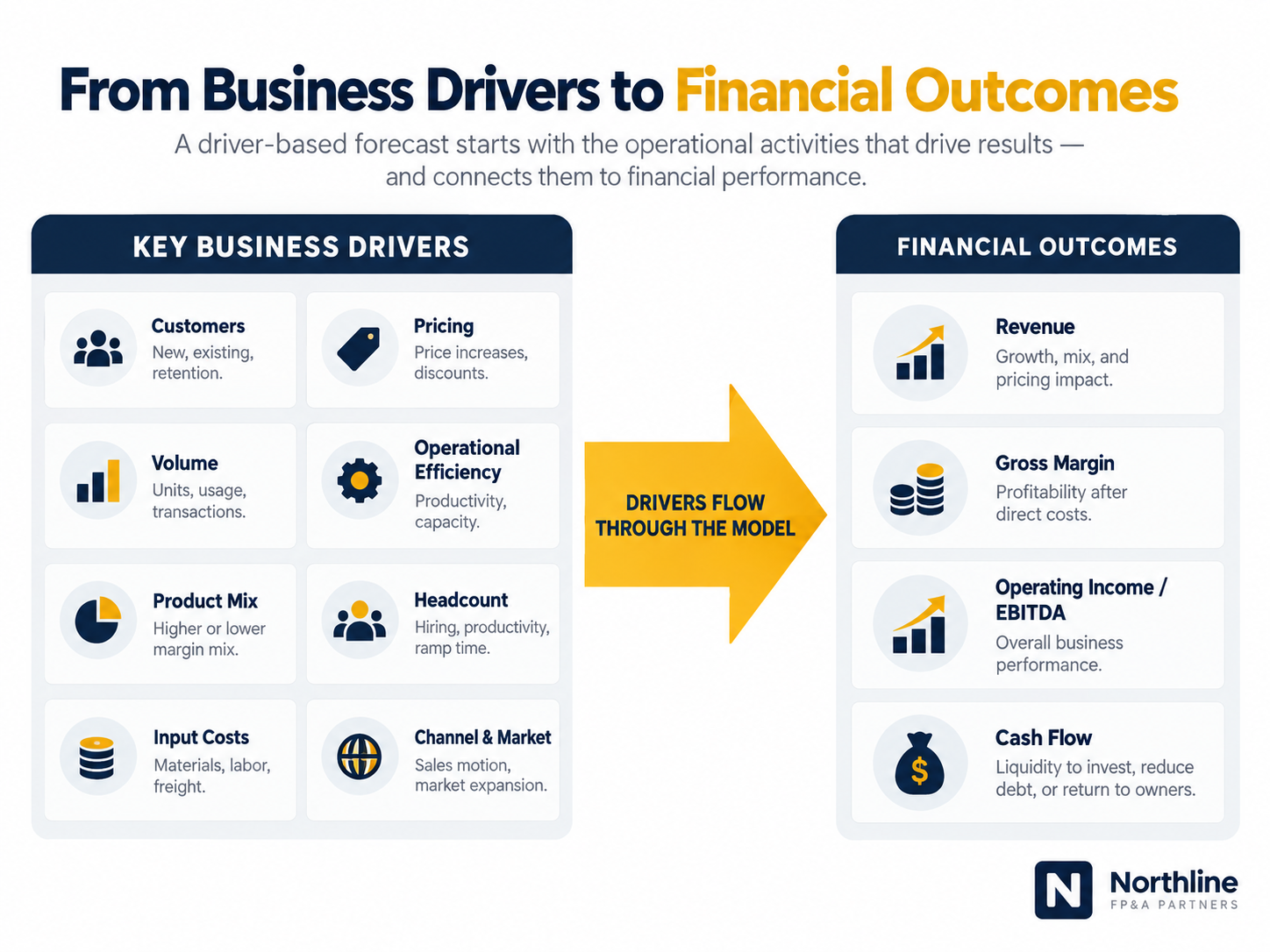
The point is not to find one universal forecasting template. There is not one.
The point is to build a forecast around the economics of your business.
Where driver-based forecasting becomes especially useful: scenario planning
Once the financial model is connected to operating drivers, it becomes much easier to answer "what if?" questions.
- What if customer churn increases from 5% to 8%?
- What if volume is 10% below plan?
- What if material costs rise 7%?
- What if we delay hiring by three months?
- What if pricing improves by 2%?
You change the underlying assumption and see the impact flow through revenue, margin, profit, cash flow, and potentially the balance sheet. That is much more useful than manually changing financial statement lines until the spreadsheet produces a number that looks reasonable.
It also helps management understand which assumptions actually matter.
A company may have hundreds of general ledger accounts, but in many cases, a relatively small number of assumptions explain most of the movement in financial performance.
Those are the assumptions leadership should spend time discussing.
This is also where rolling forecasting becomes much easier
Driver-based forecasting becomes even more valuable when combined with a rolling forecast.
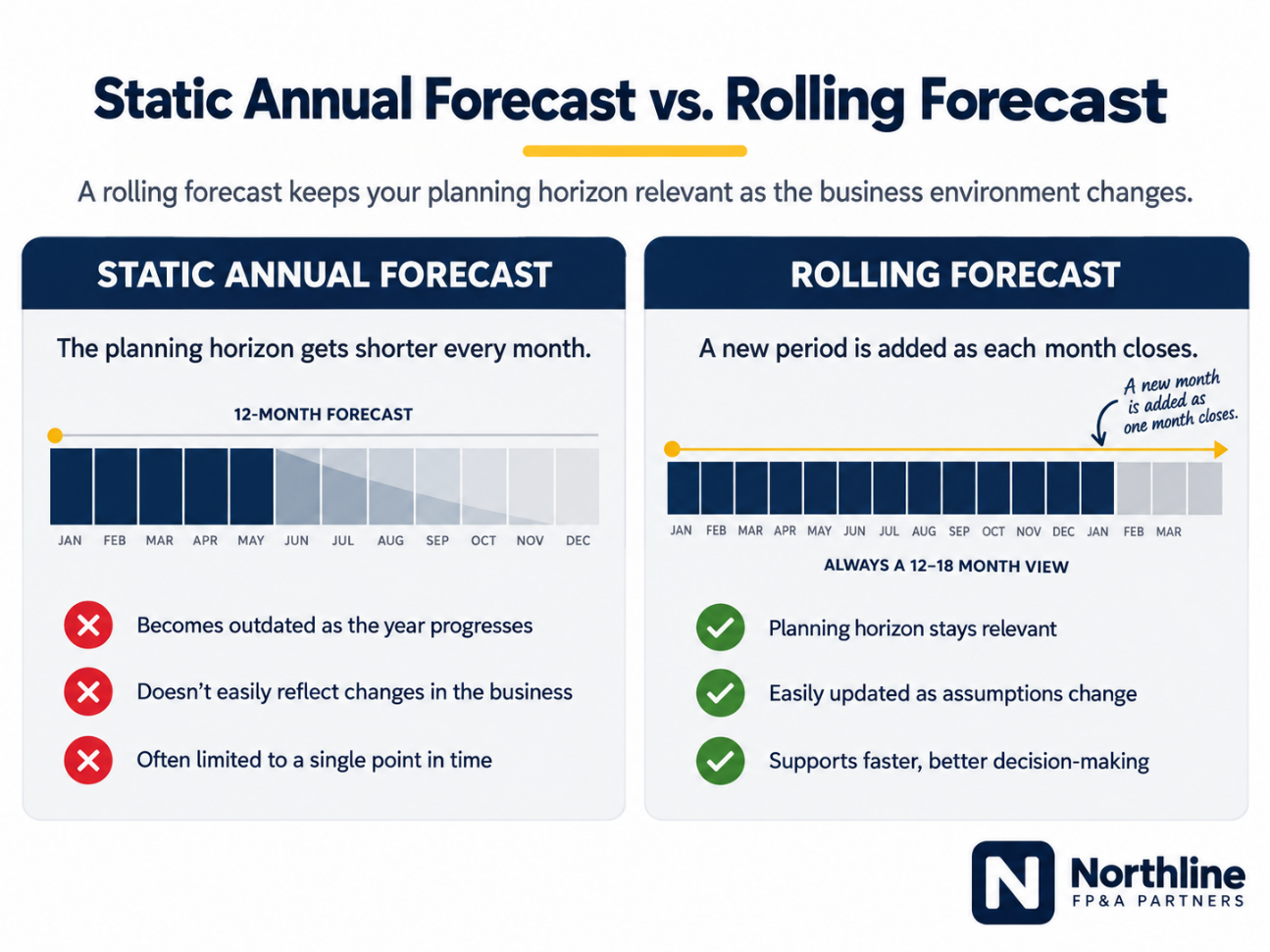
One of the biggest problems with the annual budget is that it starts getting old almost immediately.
Think about the typical process.
The company starts budgeting in the third quarter. The plan is finalized in November or December. By February or March, something has already changed.
- A major customer delays an order.
- Sales bookings are ahead of plan.
- A hiring decision moves by two months.
- Material costs increase.
- A project gets pushed into the next quarter.
- Maybe a new opportunity appears that was not even being discussed when the budget was created.
The annual budget is still useful, but some of the assumptions behind it are already outdated.
That is where companies can run into what I diagnose as plan obsolescence.
They keep measuring the business against a view of the future that's based on stale assumptions.
Budget and forecast are not the same thing
This distinction is worth making. A budget is usually a commitment or target. It says: This is what we planned to accomplish.
Budget
This is what we planned to accomplish.
Forecast
Based on what we know today, what do we now believe will happen?
A forecast answers a different question: Based on what we know today, what do we now believe will happen?
Those two numbers do not always have to be the same. In fact, they often should not be. If the business has changed materially, a forecast that has not changed may be less useful than one that has. The goal of forecasting is not to prove that the original plan was right. The goal is to give leadership the best current view of the future.
How rolling forecasts help prevent the plan from becoming obsolete
A rolling forecast continuously extends the planning horizon. Instead of forecasting only through December 31, the company might always maintain a view of the next 12 months, 18 months, or six quarters. As one month closes, another month gets added. So, the forecast never really ends. More importantly, the assumptions get refreshed. That keeps the planning process tied to what is happening in the business.
Why drivers make continuous planning manageable
The problem with continuous planning is that it can become a lot of work if finance has to rebuild every account every month.
Driver-based forecasting makes the process much more practical. You do not necessarily need to reforecast everything. You update the assumptions that changed.
A SaaS company might refresh:
- bookings
- churn
- pipeline
- hiring
- average contract value
A manufacturer might update:
- volume
- pricing
- material costs
- labor
- inventory
A professional services company might update:
- backlog
- headcount
- utilization
- billing rates
The model then translates those changes into an updated financial outlook and creates a much better monthly conversation.
Instead of asking: what number should we put in the spreadsheet?
Management can ask: what changed in the business?
That is where forecasting starts becoming part of how the company is managed rather than just another finance exercise.
A forecast is supposed to change
Sometimes management teams get uncomfortable when a forecast moves. There can be a feeling that changing the forecast means the original plan was wrong.
I look at it differently. The forecast should change when the business changes.
Customer behavior changes. Markets change. Costs change. Hiring changes.
Opportunities change. Risks change.
If none of that is reflected in the forecast, then the forecast may no longer be telling management much.
The objective is not perfect prediction. No forecasting process can provide that.
The objective is to continuously develop the best view of what is likely to happen based on the information available today. That gives leadership time to respond. And in many cases, the value of the forecast is not the number itself. It is the earlier decision the forecast helps management make.
How do you get started?
You do not need a sophisticated planning system on day one. Start by understanding what really drives the business.
I would begin with five questions:
- What causes revenue to increase or decrease?
- What causes gross margin to improve or decline?
- What resources do we need to support growth?
- What creates or consumes cash?
- Which assumptions create the greatest risk or opportunity?
Then identify the few operating metrics that best answer those questions. Build the financial relationships around them. And test the model.
- If customer volume changes, does revenue move the way you would expect?
- If headcount increases, do labor costs and capacity change appropriately?
- If pricing improves, can you see the effect on margin and cash flow?
If the relationships make sense to the people running the business, you are moving in the right direction.
Keep the model as simple as it can be—and as detailed as it needs to be
A driver-based model should not become an exercise in modeling every possible variable. More detail is not always better. You want enough detail to understand the economics of the business and support decisions.
Beyond that, complexity can become a liability.
If nobody can update the model without the person who originally built it, that is a problem. If management does not understand how the numbers connect, that is a problem too. The best forecast is not necessarily the most sophisticated one.
It is the one management understands, believes, updates, and actually uses.
The goal is better decisions, not just better spreadsheets
At the end of the day, forecasting is not about producing another finance report.
Accounting tells leadership what happened.
FP&A should help explain:
- Why did it happen?
- What is likely to happen next?
- What can we do about it?
Driver-based forecasting helps answer those questions because it connects financial results to the things management can influence.
It makes scenario planning easier.
It makes rolling forecasts more practical.
It keeps assumptions current.
And it gives management a common language for talking about the future.
Instead of debating whether next year's revenue should be $25 million or $27 million, the conversation becomes much more useful:
- How many customers can we realistically add?
- What level of pricing can we achieve?
- How much production capacity will we need?
- When do we need to hire?
- What happens if retention declines?
- What happens if demand comes in stronger than expected?
Those are the decisions that eventually create the financial result.
A useful forecast should not simply tell you where the business might end up.
It should help you understand what must happen to get there—and give you enough time to do something about it.